


I was not a rebellious child. I minded my parents and my teachers, and if they told me to do something—or not to do something—I would typically obey. This was reinforced by my favorite pre-elementary, black-and-white, mid-‘50s Nashville TV show, “Romper Room,” when Miss Norma would encourage us to “do be a Do-Bee, and don’t be a Don’t-Bee.” None of us wanted to be a disgusting and despicable don’t-bee.
My parents were both hard-scrabble representatives of the “Greatest Generation”—my mother was a “Rosie the Riveter” during WWII, and my father was a tail gunner on a B24 in the South Pacific—and neither had a high tolerance for unruly children. My father had fought off incoming fighter planes over the Pacific; by comparison, a smart-mouthed nine- or ten-year-old really wasn’t too hard to handle. Also, my school teachers—as well as my Sunday School teachers—would not have hesitated to provide my parents with an incriminating report had I “acted out” in those respective institutions (please refer to the parental-lack-of-tolerance-for-unruly-children reference above for a clue as to the consequences for my bad behavior).
Notice, I was careful to say that I was not a rebellious child; I didn’t say that I was not a rebellious kid. Or youth. Or even thirty-something. That’s because something snapped in my head when I was at my Southern Baptist college. Maybe it was because they told me I couldn’t dance. The crazy thing is I didn’t even like to dance—I just hated being told that I couldn’t. Or, maybe it was because I had spent my entire life trying to please the status quo. At any rate, I was to become the lead singer for the band (“Uncle Duck”) that played at the “Street Dance in the Middle of the No-Dancing-Allowed Campus,” but that’s another story for another blog.
When I was first offered a job in far-away New York City, I was told that I was out of my ever-lovin’ mind for packing up my old Volkswagen bus (“Van Go”) and heading north. My then-boss told me that in six months I’d be back in Nashville—or dead. There were times in those first few months that I was afraid he was going to be right. However, with the help of my old and new New York friends, I managed to tough it out and stay put (and alive!) in the city. That particular position was working in the art department of Record World magazine, and I came to love the job, the people and the city.
After three or four years at the magazine, I had an office on the 41st floor of the 1700 Broadway Building, overlooking the “Ed Sullivan Theater,” but this was in the years between “The Ed Sullivan Show” and “Late Night With David Letterman,” both of which were broadcast from the venue. It was a free-wheeling time, and the dress code was blue jeans, sneakers (or sandals) and rock t-shirts. I even created some of the t-shirts (for Stiff Records and later, for MCA and Elton John). But, then it all came to a screeching halt when Record World went belly-up in early 1982.
After looking for another art director job throughout that summer, I finally found a head hunter who promised me she could help. And, true to her word, before I knew it, I was sitting in a coat-and-tie cubicle at Doubleday’s Garden City headquarters as Art Director of their Literary Guild magazine. My job was to take the summaries of books being offered by the Guild and create marketing concepts for them. However, here is where the “don’ts” started…don’t do your own illustrations; don’t wear your sneakers; don’t skip the “Importance of Making Your Deadlines” Seminar…even if it means missing a deadline to attend.
The “Don’t Do Your Own Illustrations” rule was a little perplexing to me. The word on the Doubleday street was that some past art director had paid himself a tidy sum to create the illustrations for his publication. I was willing to do mine for free, but I was still told “no.” The up-side to all of this was that I had the budget and opportunity to work with the very best illustrators in the country. My favorite was air brush artist extraordinaire Mick McGinty; Mick had worked with Willardson and White in L.A. before becoming the original “Joe Camel” artist and creating numerous album covers, movie and Super Bowl posters and billboard campaigns. Mick was always the one I went to first when I had a crazy concept that only an airbrush illustration could capture.
And that was the case when we were asked to create the marketing look and feel for Bob Woodward’s soon-to-released bio, “Wired: The Short Life and Fast Times of John Belushi.” This was in early 1984, and the loss of the comic genius just two years earlier was still a lingering hurt. Like the promising stars before him that had died the same way and much too young—Jimi Hendrix, Janis Joplin, and Jim Morrison—Belushi had been so much larger than life. He was our generation’s Abbott and Costello, Jackie Gleason, and Jerry Lewis all rolled up in one big package. I had been a fan of his since we sat around our off-campus apartment back in 1974, listening to his work on National Lampoon’s “Lemmings” album, which parodied (okay…lampooned) Woodstock. After “Saturday Night Live” and then, “Animal House,” we thought Belushi was destined to become one of the all-time comic greats. After reading the synopsis of the Woodward book, however, it appeared as if the Hollywood lifestyle had been as much to blame as the actual drug overdose.
The “don’ts” regarding the marketing direction of Woodward’s book started at the preliminary editorial meeting.
“We’re walking a fine line here,” the editor said.
“A ‘Wire’,” I said. She didn’t laugh.
“Don’t even think about any sort of drug reference in the marketing or illustration,” she said.
“What do you mean?” I asked.
“I mean, don’t try to sneak in something like a…doobie,” she said. From the way she crinkled her face when she said it, I could tell she had probably never in her life uttered the word, “doobie.”
“But that’s what the whole book is about, according to the summary,” was my puzzled response, “Drugs…and how they destroyed the promising life of Belushi.”
“That’s beside the point, so again, don’t even think about any sort of drug reference in the marketing or illustration,” she repeated, this time a little more loudly.
“What about a Hollywood reference?” I asked. As I mentioned, it seemed like Belushi’s Hollywood life-in-the-fast-lane had been as big of a factor in his death as the drugs that actually ended his life.
“The Hollywood reference is fine,” she said, rolling her eyes, “but again, don’t even think about any sort of drug reference.” (“If you want to keep your job,” was the innuendo).
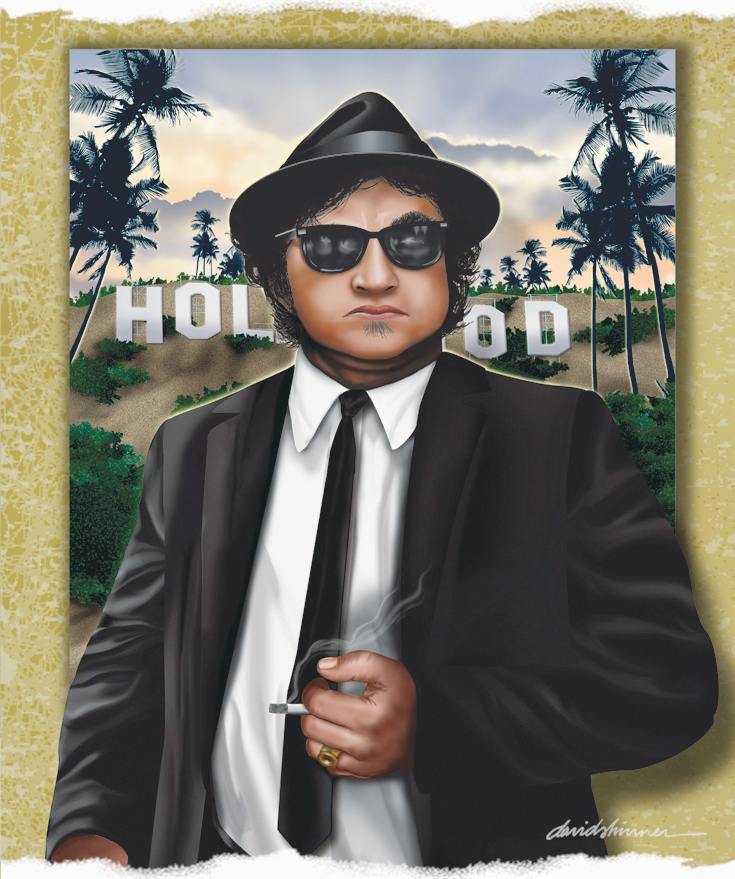
And so, I arrived at the concept of Belushi standing in front of a “Hollywood Sign” movie poster on his wall, but with a sunrise over the hill, illuminating him from behind. As before, Mick McGinty hit it out of the park. However, by the time it printed, I had moved back South, this time to Atlanta to help create a print-and-design company with two partners called Indelible Inc.
That was thirty years ago, and looking back, I realized how frustrating it was to always have to hand off my ideas and concepts to other (albeit, very, very talented) illustrators. Especially, after being constantly told that I couldn’t do it myself.
Over the past year or so, I’ve gone back and resurrected projects from my past that I wanted to digitally illustrate (or re-illustrate) using Adobe Illustrator and Photoshop; the “Hollywood Belushi” picture was the most recent one to fall into this category. So, with one fell swoop, I’ve gotten to “do” what I was told “don’t do”—I’ve done my own illustration and I’ve included a drug reference in the same illustration. Actually, the original “Hollywood Belushi” art that Mick did all those years ago included the same subtle drug reference—right over Belushi’s left shoulder and right under the editor’s nose. Even back then, I felt like it was only right to spell out the two things that helped end the life of one of our generation’s most brilliant comics. All it took was to use the deceptively-welcoming iconic sign in the background. And, besides, “OD” spelled backwards is, of course, DO.
 David Ray Skinner